
Pushing Out the Boat: Our Blog
- The Launch of Tides in Time (Naomi Greenwood, posted 8 May 2026)
- In Praise of Pushing Out the Boat (Shane Strachan, speaking at the launch of Tides in Time, posted 8 May 2026)
- Spotlighting North East Magazines (Naomi Greenwood, posted 13 Nov 2025)
- The Power of the Sea (Roger White, posted 24 Jul 2025)
- Launch of Issue 18 (Naomi Greenwood, posted 4 Jun 2025)
- Gail Riekie, 1958 – 2024 (Roger White and Aenea Reid, posted 30 Jan 2025)
- Wee Gaitherin Heritage Exhibition (Webmaster, posted 15 Nov 2024)
- Writing Creatively about the Sea (Blair Center, posted 30 Aug 2024)
- Meet the Panellists (Naomi Greenwood, posted 23 Aug 2024)
- The Power of the Sea, the Power of Words (Roger White, posted 10 Aug 2024)
- Introducing the new editor, Peter Burnett (Peter Burnett, posted 17 May 2024)
- Pushing Out the Boat all the way to Stirling (Naomi Greenwood, posted 13 Apr 2024)
- From Fiddle to Boat - a piece of North East history (Naomi Greenwood, posted 2 Mar 2024)
- Sheila Templeton: a personal appreciation (Judith Taylor, posted 29 Jan 2024)
- Across the Silent Sea: A Novel by Gabrielle Barnby (Lily Greenall, posted 24 Oct 2023)
- View from American Poet, Elizabeth McCarthy (Elizabeth McCarthy, posted 21 Sep 2023)
- Q&A with Loraine Mudie, WordsUp presenter (Naomi Greenwood, posted 6 Aug 2023)
- POTB at Books and Beans June 2023 (Roger White, posted 1 Jul 2023)
The Launch of Tides in Time
posted on 8 May 2026
The Launch of Tides in Time: 25 years of Pushing Out the Boat
On Sunday 3rd May, we were joined by contributors and friends spanning generations in the unique launch event of our 25th anniversary anthology, titled Tides in Time.
The year 2025 (very satisfyingly) marked the 25th year of production of Pushing Out the Boat magazines, a milestone only possible thanks to the continued outpouring of talent from the North-East of Scotland and beyond, combined with the dedication of our changing team of volunteers over the years. An anthology of some of the best prose, poetry and art from all our issues produced in this time was the only sensible way to celebrate this milestone.
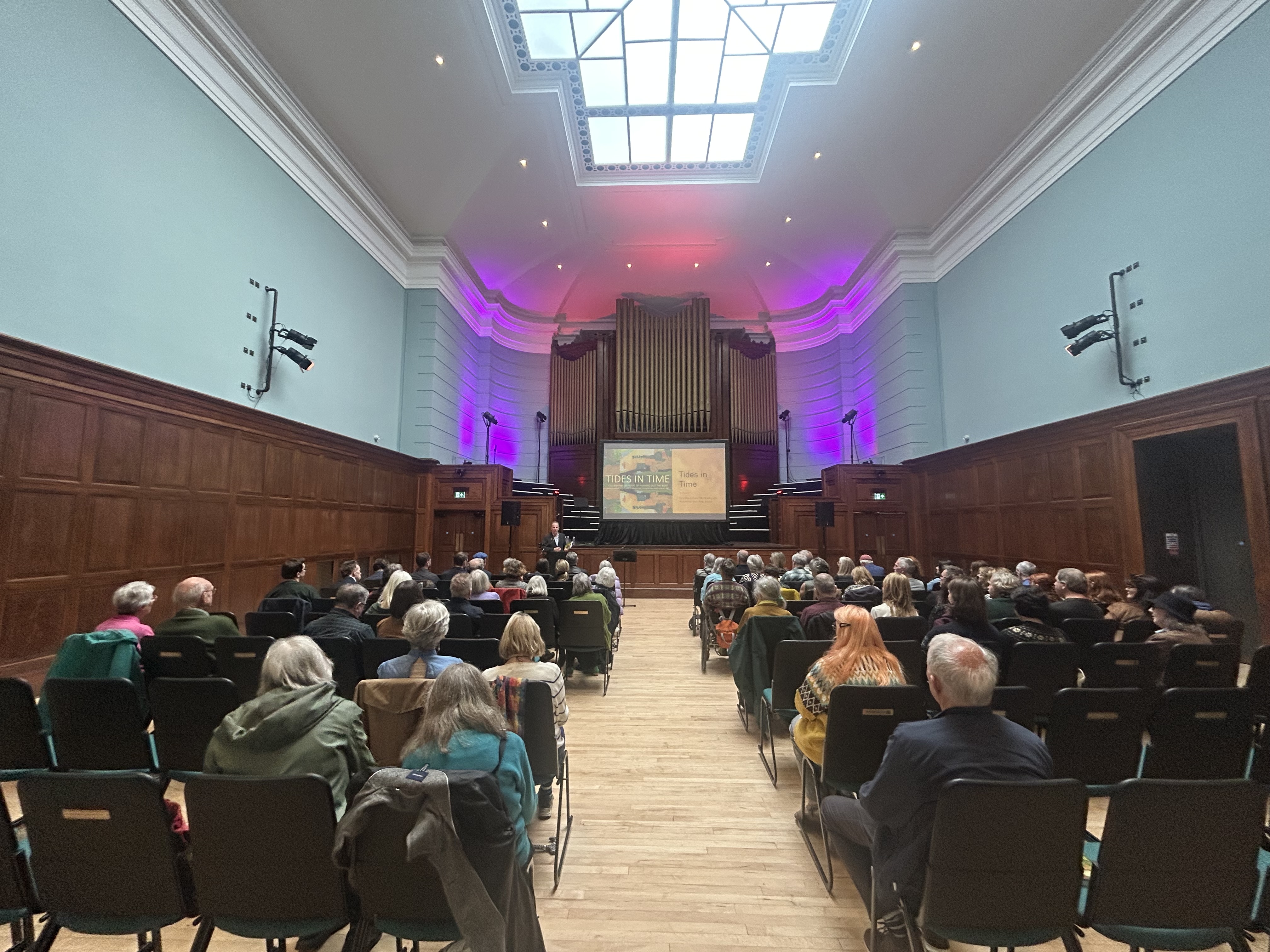
Aberdeen’s Cowdray Hall opened its doors to an enthusiastic audience for an afternoon of entertainment: selected artists’ work on display, readings and recitals from prose writers and poets. Before the programme of readings commenced, the audience were treated to a slideshow of all the art reproduced in the anthology, including the cover image by Kathryn McFarlane. The event was wonderfully compered, as always, by our editor Peter Burnett.
 We were pleased first to hear from the City’s Depute Provost Councillor Steve Delaney, who spoke to the Culture Investment grant awarded by Aberdeen City Council which made the anthology possible.
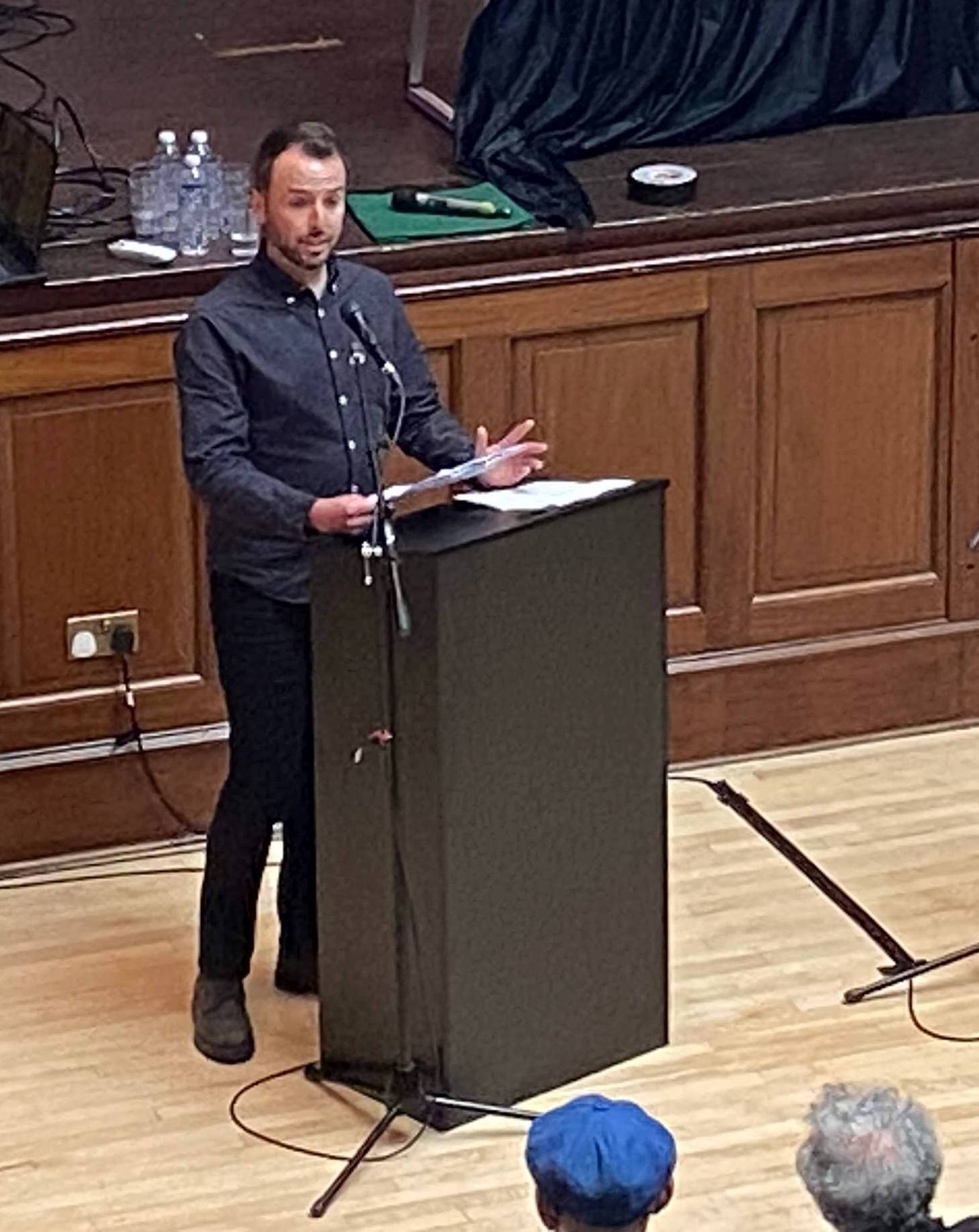 Following this, writer, performer and former Scots Scriever Shane Strachan spoke ‘In Praise of Pushing Out the Boat’, summing up the value of the magazine for the wider literary ecosystem of the North-East. He described the magazine as the only one with a system of selection panel sensitive to the nuances of local voices alongside a worldwide lens. He particularly praised our efforts to include contributions from young people, the future generation of writers and artists. The full text of his contribution can be read here.
Here is a full list of the afternoon’s readings. As well as their inclusion in the anthology, we still have a small supply of the original magazine issues for sale, where each can be seen in its original context.
Photos of all the readers can be viewed below in the Launch Photo Gallery.
Poet Knotbrook Taylor started things off with his poem While you were sitting there from Issue 15.
Linda Smith read from her story Christmas in Doune (Issue 3).
Eleanor Fordyce read her Doric poem Wish You Were Here (Issue 12).
Frank Woods read from his story The Wee Man (Issue 1)
Julia Shannon recited her late father Gerard Rochford’s poem Ironing a Sari, complete with the original sari on display (Issue 10)
Donnie Ross read from his story Scunner in the Gallery (Issue 9).
Alison Green read her poem The Droont Quine being (Issue 17).
Our youngest featured poet, Lucy Sutherland, recited I’m a Poet (if Nothing Else) (Issue 18)
Kate Percival read her story Cold Coffee (Issue 6).
Lesley Benzie read her poem Divorced Fae Reality (the second contribution from our very first issue).
John Bolland read The Lady Who Lunched from his Three North-East Vignettes (Issue 14).
Gillian Shearer read her poem Mither Tongue (Issue 17).
And finally, our ex-editor and long-time team member Martin Walsh treated us to his poem New York Dialogue (Issue 14).
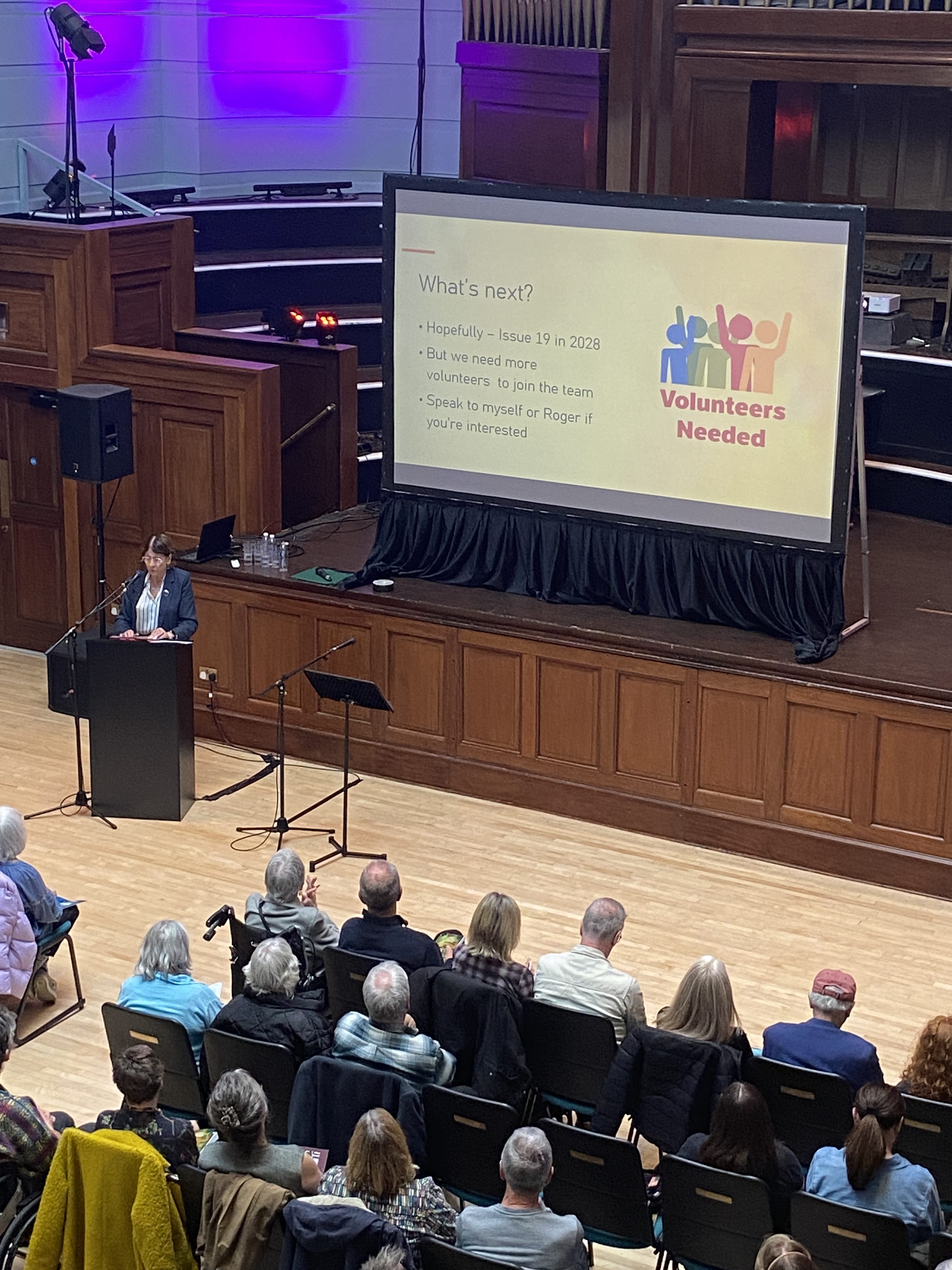 The formal programme concluded with Pushing Out the Boat chair Aenea Reid reflecting on the successes and challenges of running a professional-produced magazine with an all-volunteer team. She called for new volunteers to join the team, to fill some gaps and bring fresh energy and new perspectives. Writers and artists would be particularly welcome as would those willing to help with administration and publicity. If you think you might be interested in coming aboard, please drop an email to info@pushingouttheboat.co.uk.
The programme was followed with a chance for everyone to share a celebratory drink, chat to our readers, and for some, to meet old friends.
 The significance of the Cowdray hall for an event such as this cannot go without mention. Pushing Out the Boat was the first magazine to showcase some of the work of local artists now much wider known, some displayed in Aberdeen Art Gallery, who manage the Cowdray Hall. At a pivotal time in the production of the magazine, this felt like a ‘full circle’ moment.
Special thanks go to the helpful Cowdray Hall staff members involved on the day, and to Aberdeen City Council whose Culture Investment grant enabled the bringing together of cross-generational talent both in print and in person. Most of all, we are grateful to our contributors, new and returning. It goes without saying that it is a privilege to be a vessel – no pun intended – for talent across and beyond the North-East.
Gallery of Photos taken at the Launch – click on an image to start the slideshow
In Praise of Pushing Out the Boat
posted on 8 May 2026
I’m going to start off today by reading a poem from Issue 17 of Pushing Out the Boat, for which I was asked to write the foreword back in 2023. It is by E M Strang and is called ‘Angel Shades’:
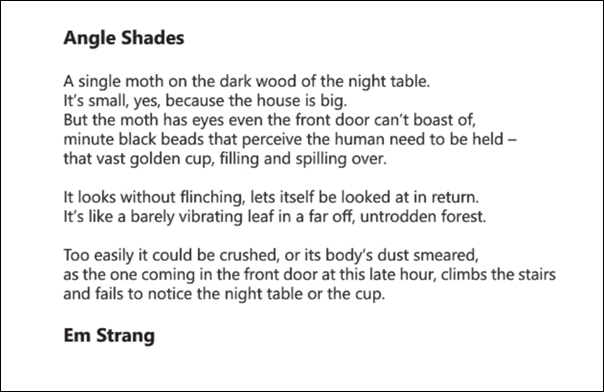
As I noted then in my foreword, the first line of the middle stanza could easily be a description of poetry itself: ‘It looks without flinching, lets itself be looked at in return.’
It is a poem that reminds us of the power of turning away from the fast-paced flood of distractions in our lives to give our full attention to something before us, to take it in, as though in slow-motion, as though seeing it for the first time. This is the gift that literature gives us. And this is the gift that Pushing Out the Boat has given us for the past 25 years in the North East of Scotland, providing a platform for writers near and far – young, emerging and established – to share vignettes and stories from their lives and imaginations with the wider world.
Opposite Strang’s poem in Issue 17 was a mixed-media collage by Kathryn McFarlane which has gone on to be the beautiful cover of the Tides in Time anthology. The title of the artwork is ‘Soaring High’, and I hope that everyone who has been involved with Pushing Out the Boat over the years is ‘Soaring High’ today for helping to keep a magazine of such high quality going all this time.
It is something of a miracle that a regional writing magazine, or any writing magazine for that matter, can last as long as Pushing Out the Boat has. Having published my work in literary magazines for over 15 years now, I have seen many magazines come and go, often within the first few years of their inception, if not the very first.
A magazine is often started by a writer or group of writers who want to provide a platform for creative work they enjoy. From that point onwards, so much is against the magazine actually coming into being – finding funding to pay for it, finding the time to work on it, and, of course, finding great writing…! And then there’s managing interpersonal relationships; the differences in tastes, style and approach; deciding whether to be a CiC, a social enterprise, a charity or some other organisational model, and all the bureaucracy that comes with these options; then people coming and going, and, of course, real life just getting in the way…
In the opening to Tides in Time, editors across the years reflect on the hard work and sacrifice it took to get the magazine going, and to keep it going over the years, from the first editors Magi Gibson and Mindy Grewar, through to Martin Walsh and Judith Taylor, and more recent editors, including the youngest Lily Greenall, who helped steer it through Covid, all supported by their wider teams of hardworking volunteers.
I, like many other writers in the North East, am very grateful for Pushing Out the Boat’s existence. Regional magazines are a very important part of a wider literary ecosystem, providing both emerging and established writers a means to connect with audiences on both their doorstep and further afield with works that might take risks with form or voice that mainstream publishers and larger outlets often won’t give a chance.
For instance, back in 2013, I wrote a story for my PhD from the perspective of a young girl of both Scottish and Mexican parentage who speaks in a mix of Mexican Spanish and Doric Scots. It went on to appear in the 13th issue of Pushing Out the Boat in 2015, and I’m pleased to say is also in the Tides in Time anthology. I truly believe that POtB is probably the only magazine that would have a panel sensitive to the nuances, playfulness and experimentation of this unusual voice, and who would have a dual lens of the local North East view, alongside a more global outlook, to publish this story set in the Mexican coastal city of Mazatlán where a young girl speaks of Spongebob Squarepants, her black affrontit padre, and getting her culo skelped!
This duality of having an eye on the local and the global can be seen in the selection of high quality work in Tides in Time which features writing and artwork from across Scotland, the rest of the UK and much further afield including the USA, the Netherlands, Australia, Ireland, France, Palestine, and Taiwan.
Notable Scottish authors from outside of the northeast abound including Donald S Murray, Lesley Harrison, Mandy Haggith, Lesley Benzie, and Scotland’s Makar – Gaelic poet Pàdraig MacAoidh. It also features many stalwarts of Aberdeen’s poetry scene, reflecting and feeding back into the local literary ecosystem across the years, with the likes of Sheena Blackhall, Sheila Templeton, Gerard Rochford, Ian Crockatt, and Olivia MacMahon, who passed away late last year.
I particularly enjoyed reading work from more recent issues by some Next Big Things, including prose from Edinburgh-based Sarah Whiteside, poetry and prose from Berlin-based writer Zoe Green, whose debut collection Charm came out last month, and Borders writer Craig Aitchison whose debut poetry collection Flichter comes out on Thursday!
And of course, we cannot forget about the wealth of artists included in this 25 year celebration, such as David and Jane Pettigrew, Paul Barnes, and Kate Steenhauer, whose work is currently on display upstairs in the gallery in a brand new exhibition on changing energy narratives in the North East. Pushing Out the Boat was the first to ‘exhibit’ this work as far back as 2015 in issue 13.
For me, a particularly special thing about POtB is that it has always given space to young talent, something many other literary magazines would quite frankly snub and run a mile from. Having a platform for children and young people to get the validation and encouragement of a real publication has proved very fruitful for all involved.
For instance, back in 2009, six-year-old Malcolm Cowie had his poem ‘Cold Times’ published after winning POtB’s Junior Writer Award. He continued on a creative path and has since graduated with a BA in Acting from the Royal Central School of Speech and Drama, London. At the age of 17, Hannah Kunzlik had her story, ‘Last Journey Home’ published in issue 7 in 2010, and she now runs a site celebrating and analysing fantasy literature which is read by thousands globally!
This is what I mean when I talk about the importance of Pushing Out the Boat to the literary ecosystem of the North East, if not the wider creative and cultural ecosystem – only with 25 years behind us can we now look back and see that from small seeds, trees have grown and much fruit has been borne at the hands of the magazine.
To be on the selection panel deciding who gets to be part of these wonderful and inspiring publications is a special privilege. For me, and many other writers in the North East across the years, to be given the opportunity to sit on one of the panels is a gift in that you learn so much about what makes a poem or story work, and what aspects might be holding a writer back from making it into the final published mix, which you can then learn from and take into your own practice.
For anyone who’s been stung by rejection – no writer can say they haven’t been – it is something of a reality check to be on the other side and realise how hard it is to make these choices, and to have to turn down some great works in the years where the submission pool is of a particularly high quality.
It’s no easy job – it requires hours of work and, having sat on both the poetry and prose panels at different points, I can say that one form is definitely not easier to be on the panel for over the other.
Over ten years ago, when I would still be classed as a ‘young’ writer, it was also a great opportunity to be on the magazine’s committee, and to be welcomed so warmly into Martin Walsh and Freda Hasler’s home. They both had such a talent for bringing on board people with the right skills to pull off various jobs across the team to a professional standard, from doing the accounts and running the website, to marketing and promotion, and typesetting and editing. I was always so impressed with how caring and meticulous everyone was with their individual roles, which is reflected in the quality of the final publications, typeset and proofread to a standard that many mainstream publishers struggle to achieve!
One final point I wanted to make in celebrating the impact of POtB over the past 25 years is its role in changing perceptions that writing in and from the North East is parochial and insular, or only concerned with old-fashioned and tired subjects. While there is always more work POtB – and all of us – could be doing to ensure greater representation of the North East region’s rich cultural diversity, the magazine has fairly done its bit to progress away from the North East’s tendencies in the last century to write works which were overly sentimental, overly nostalgic or inward looking.
As the magazine’s name invites us to, let’s keep pushing out the boat towards new horizons and new ways of seeing our region and the wider world. Here’s to 25 more years of Pushing Out the Boat!
Spotlighting North East Magazines
posted on 13 November 2025
Spotlighting North East Magazines: Causeway/Cabhsair Magazine with Pushing Out the Boat
Those of you in attendance at our recent WayWORD Festival event, “Spotlighting North East Magazines”, will agree it was a fantastic celebration of new Scottish prose and poetry.
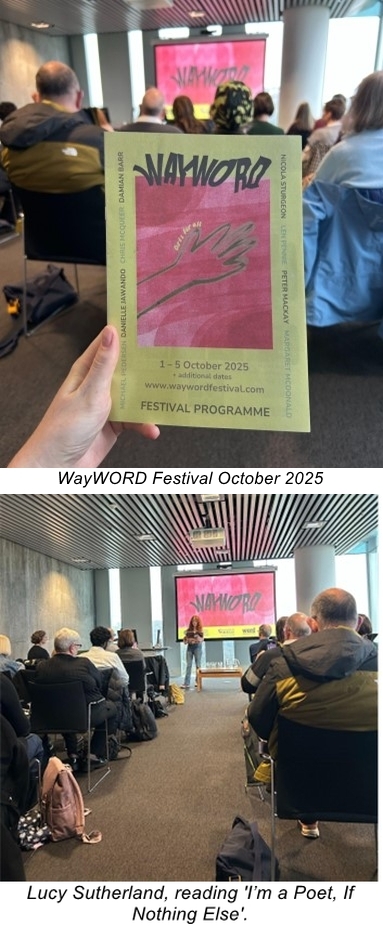 Hosted in one of the University of Aberdeen’s Sir Duncan Rice Library conference rooms, the event on 1st October took shape thanks to the coordination of 2022-2023 Scots Scriever, Dr Shane Strachan, who organised this year’s WayWORD festival. The annual event aims to empower young people to “produce a cross-arts literary festival in Aberdeen” – something we are proud to get behind as a magazine, encouraging young people of school-age to get involved and get their names “out there”. Pushing Out the Boat has maintained connections with WayWORD festival for some time including participating in past events. We were also lucky to have Shane write the foreword for our 17th Issue, which you can read here.
Pushing Out the Boat were joined by Causeway/Cabhsair magazine who launched their 14th issue with a bang, highlighting their own contributors at the event. Causeway aims to publish new poetry and prose by Irish and Scottish writers, including all languages of both countries, and has been published since 2010 (not quite as long as Pushing Out the Boat but still impressive).
Three of our own contributors were delighted to perform alongside members of the Causeway crew making for a refreshing mix of new writing. Spotlighting Pushing Out the Boat Issue 18, Lucy Sutherland, read I’m a Poet, If Nothing Else, her first published piece, George Duncan read Unrecognition and another of his own poems and Donna Ewen performed her Doric short story Hellfire Corner, set in World War II. Causeway readers followed suit, some having traveled from far and wide to perform on the day.
As well as welcoming new audience members at each of our events, Pushing Out the Boat are lucky to host regular attendees who may now be familiar with some of our contributors and their work. I am sure the same can be said for Causeway magazine; this event was a chance for both audience and performer to experience a taste of something new and enticing. Members of both magazine teams introduced their respective contributors who delivered a range of readings spanning across several dialects.
Pushin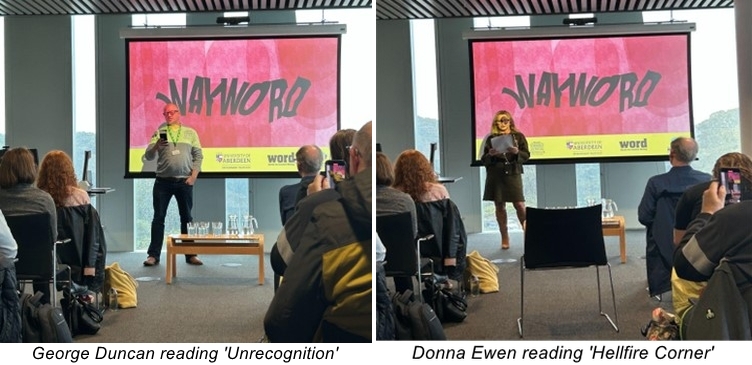 g Out the Boat were delighted to collaborate with and expand our knowledge of Causeway/Cabhsair magazine at this special event, and we congratulate them on the publication of their 14th Issue. We thank Dr Shane Strachan and the University of Aberdeen for the opportunities that WayWORD festival presents, not just for the magazine but also for the young people of North-East Scotland.
The Power of the Sea
posted on 24 July 2025
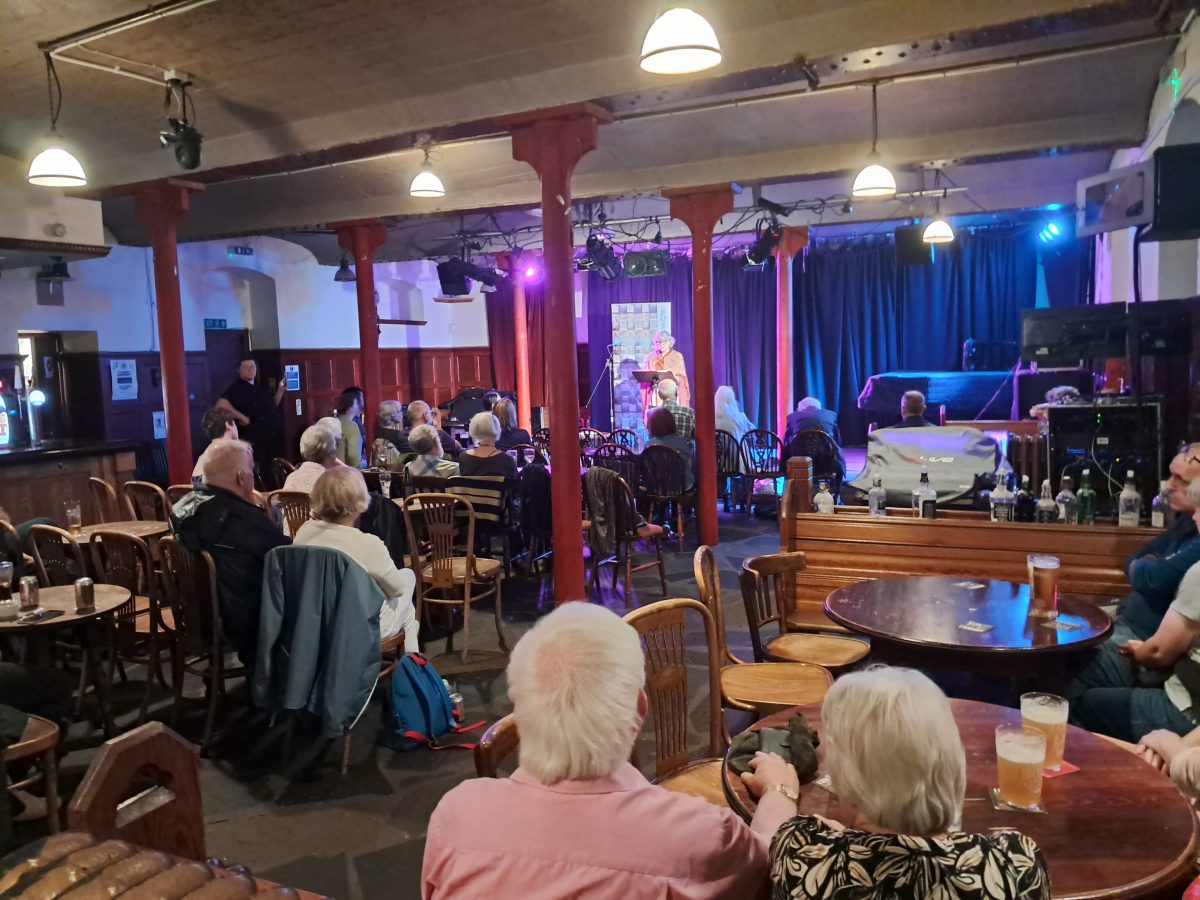
Blue Lamp, 20 July 2025
If the Tall Ships are in town, you need a Festival of the Sea to celebrate them. And if you have a festival, you have to include your own city’s arts magazine, Pushing Out the Boat.
So it was that we added our own voice to salute what we called The Power of the Sea, in an afternoon of stories and poems in Aberdeen’s Blue Lamp pub. Our maritime heritage and location mean that our contributors have responded creatively in manifold ways to our watery neighbour. We invited eight to contribute their work from our magazine as well as other relevant pieces.
Singer Annie Reid set the mood for us with the Burning of Auchendoun, Tatianna by Linda Kelly and Fisherrow, returning at the interval with Ferritin by Norman Burns, June Imray’s Quine That Did The Strip at Inverurie, and The Pirate Song by Dan Freed.
Here’s the work from the magazine our readers shared.
Chandra Gair’s eponymous poem ‘Aberdeen’ from our latest magazine (Issue 18) was a good place to start with its portrayal of ‘a crude city … off the wild north sea/icy grey granite’.
Bernard Briggs followed with a medley of poems centred on ‘Darcie’ (Issue 17), a meditative response to seeing the name spelt out in shells on a West coast beach, only to be washed away when the narrator next visits, ‘Your name had gone/Were you ever there?’
As well as two poems in the magazine (‘True Colours, Issue 18, and ‘Blue Egg’, Issue 17) Nicola Furrie Murphy gave us a glimpse of ‘Thermopylae rime’, a work in progress about the tea clipper built in Aberdeen.
We ended our first half with a group of poems in the Doric by Alistair Lawrie, including ‘Switherin (Harbour of Refuge)’ (Issue 16) – ‘Black nichts/ye peer oot fae the pier at seas ye canna/see’.
Eleanor Fordyce kicked off our second half with two short stories. In ‘A Day Out’ (Issue 9) we joined the narrator on the beach with a dying companion – ‘This is exactly where I want to be, where I want to come … after. Do it on a day like today; just you, and the wind to take me where it will’. In ‘The Lost Shoe’ (Issue 13) Rosie, aged 8, demonstrated prescience beyond her years.
Alexander Inglis’ poem ‘Droukit Steen’ (Issue 18) tested this listener’s knowledge of the Doric with the ‘greeting screich [of] malies, pirries, scorries’. Scorries I knew (and try to love). Malies and pirries were new to me*.
A change of mood brought us Martin Walsh’s story about ‘Walrus’, a lost soul who spends a few days in an outhouse in Torrie (of course). ‘Walrus’ was written for a crowdfunder we held and is on our website.
Finally, Judy Taylor offered us her poems ‘Ashore’ (Issue 8) and ‘Ship to shore’ (Issue 13), ending with the poignant ‘Cliff Walk in the Haar’ (Issue 18) by our late secretary Gail Riekie.
Our thanks to our readers, singer Annie Reid, our colleague Aenea who compered the event, and of course the Blue Lamp.
Our magazines are for sale in our online shop.
* Malie – fulmar, pirrie – tern, scorrie – gull [Ed]
Gallery of photos taken at the event plus a few snaps of the Tall Ships in Aberdeen – click on a thumbnail to view fullscreen.
Launch of Issue 18
posted on 4 June 2025
For those in attendance at the Launch of our 18th Issue on Sunday 18th May, I’m sure you will agree it was a successful and happy occasion. For those who couldn’t make it, our PR Manager recounts the event.
 The long-anticipated Launch of our 18th Issue was held once again at Newton Dee’s esteemed Phoenix Hall, Bieldside, Aberdeen, and welcomed contributors showcasing featured art, poetry and prose. Doors opened at 1.30pm, welcoming contributors and guests including Aberdeen’s Lord and Lady Provost to the reception area for drinks, nibbles, and a first in-person look at some of the enticing artwork featured in the magazine.
The high ceilings and skylight windows made for a bright and open atmosphere as attendees filed in to register before taking a peek at paintings and photos hung up by some of the amazing artists featured in the latest Issue.
Drinks and light nibbles were available for guests as they milled around the entrance hall admiring featured artwork before being directed toward the auditorium to hear our writers and poets perform.
Pushing Out the Boat’s Chair, Aenea Reid, kicked off the festivities with an opening speech and read the words of this year’s foreword author, Sheena Blackhall, who compared the magazine to “Noah’s Ark,” perhaps for its melange of content and genres. Aenea then welcomed special guest, Aberdeen Lord Provost, David Cameron, to the stage, who had the exciting task of announcing some upcoming news on behalf of the magazine.
Exciting announcement for Pushing Out the Boat
Aberdeen Lord Provost David Cameron was happy to share on behalf of Pushing Out the Boat that, to mark its 25th Anniversary, the magazine will be publishing a special anthology Issue! Met with an excited “oooh” from the audience, Dr Cameron’s announcement included details of a grant provided by Aberdeen City Council which will enable the production of the anthology. The contents will include selected poetry, prose and artwork featured in magazine issues gone by in an enticing celebration of twenty-five years of Pushing Out the Boat.
With the excitement out of the way, it was time to settle into the first half of our readings. Pushing Out the Boat’s editor, Peter Burnett, was delighted to compère the event. Having taken time getting to know each performer, he hailed each individual in turn to the stage with a friendly smile and a warm welcome.
Though it feels wrong not to detail the contents of each and every performance, it would likely spoil the magic a little – and I certainly wouldn’t do each performer justice. If you’re keen for a read of the real thing you’ll just have to order a copy of Issue 18 for yourself.
Kicking off the reading was Brian Nisbet Prize winner, Nicola Furrie Murphy, with her poem, ‘True Colours’ (p36). With features in several popular Scottish publications, Nicola was a great choice to start the show.
Donna Ewen then read her short story, ‘Hellfire Corner’ (p24), in her beloved Doric.
Bobbi Thompson travelled from Glasgow to read her beautiful poem, ‘Where the Blue Flowers Grow’ (p47).
George Duncan followed with his captivating poem, ‘Unrecognition’ (p61).
‘Things That Are Sleeping’ (p77) was the next poem, performed by poet and editor Elizabeth Rimmer.
Next up, Alan Donaldson gave us the highly entertaining story ‘Oh What a Pickle’ (p64).
Our first young performer, Lucy Sutherland, read ‘I’m a Poet (If Nothing Else)’ (p42), her first published poem.
Knotbrook Taylor rounded up the first half of readings with his poem, ‘The Fox Inside of Me’ (p67).
A short interval ensued for more refreshments, chatter and compliments to the first set of readers.
It was Andy Jackson who kicked off the second half, with his medical-themed poem ‘Going Under’ (p19).
Our second young performer, Fraser Paterson, brought the hilarity of ‘Buffet Barry’ (p44) to the audience, a short story comparing a buffet guest to a soldier in the trenches, defeated by the pile of food before him.
Anne McClure’s poem, ‘Half Doric’ (p62), told how her Doric spikkin Father never used any words of warmth or kindness.
Poet Sandra Millar was up next with ‘Little Stargazer’ (p13), an intimate reflection of the birth of her child.
Sarah Coakley treated us to some travel writing with ‘Felis Silvestris Silvestris’ (p71).
‘Mr Greenwoods’ (p6), a short story by Wanda McGregor, elicited many a chuckle.
‘A Cliff Walk in the Haar’ (p91), a poem by our late secretary, Gail Riekie, was performed by Pushing Out the Boat team member Judy Taylor.
Poet Rachel Tennent used alchemy as a metaphor for her sister’s declining memory in ‘Mining My Sister’s Memory’ (p69).
And finally, Karen MacFarlane’s poem ‘Dundee Law is Not a Volcano’ (p22), rounded up the afternoon beautifully.
Aenea Reid took the stage one last time to express a series of “thank yous.” I can only reiterate them here; Pushing Out the Boat are grateful to Newton Dee for providing their fantastic performance venue, to the Lord and Lady Provost of Aberdeen for their attendance and endorsement, to those guests who both attended the event and support the magazine in many other ways, but most importantly to our wonderful contributors who time and time again provide us with rich and diverse content to share with Aberdeen/shire, and the wider world.
Then, before everyone went home, there was time for a group photo of participating readers and artists.

Back row (left to right): George Duncan, Michelle Will, Sarah Coakley, Peter Burnett
Third row: Sandra Millar, Alan Donaldson, Fraser Paterson, Gemma Hare, Rachel Tennant, Andy Jackson
Second row: Donnie Ross, Ruth Simpson, Wanda McGregor
Front row: Nicola Furrie Murphy, Elizabeth Rimmer, Marka Rifat, Anne McClure, Karen MacFarlane
More photos of the proceedings, can be viewed in the photo gallery below. Click on a thumbnail to view as a slideshow.
Gail Riekie, 1958 – 2024
posted on 30 January 2025
 Last month, we reported the death, far too soon, of our secretary Gail Riekie, and we promised ourselves a longer tribute would follow.The plain facts of Gail’s membership of the Pushing Out the Boat team are simple. She became our secretary in 2016 and served us diligently until pancreatic cancer was discovered in Autumn 2024 and took cruel and rapid control of her body. She was also a trustee of our charity. In a small group of volunteers, which is what we are, you can give someone a job title. But the truth is that the effective colleague turns their hand to many things, and Gail did, with goodwill and only the occasional wry smile at the shortcomings of others.
One of Gail’s tasks was giving the good news to contributors who had their submissions to the magazine accepted. She asked them to provide a 30-word biography to include in the magazine. If they complied with the brief, and on time, collating their contributions was easy enough. Alas, a minority not only needed chasing to deliver, but would offer up 45, 70 or more words with the glib advice ‘Feel free to edit’, or worse, ‘You can find my biography on my website’. Undaunted, Gail distilled the essence from these offerings, cutting the words, though never the authors and artists, down to size.
Gail’s brother Max and his family organised a celebration of Gail’s life on 24 January in Aberdeen that brought home to us how wide-ranging her talents and interests were. She was not only a scientist and a geologist with a long career in the oil industry, but also a lover of nature, a keen walker and even keener lifelong cyclist, a speaker of German, a former chair of an Amnesty group, a family historian (Nottingham-born, she described how she’d found family graves in Fife’s St Monans kirkyard), and a dog owner, latterly of her fox terriers Bertie and then Nobby. Nobby joined our last meeting that Gail was able to attend in October, via Zoom, sitting patiently and poignantly with her on the sofa as she watched our proceedings at a distance.
 And so we come full circle to Pushing Out the Boat’s purpose – giving a platform to fine writing and art, especially from but not confined to North East Scotland. It was through first Bertie’s and then Nobby’s blog (Nice Nobby, Naughty Nobby) that we came to know Gail was also a photographer and writer, albeit in the furry guises of Bertie and Nobby.
What her many friends from those other parts of her life may not know is that Gail also wrote poetry. She submitted (anonymously, as everyone does) a poem for the next issue of our magazine. It is a fine and touching piece, and we’re pleased to say it will be published along with much other fine writing and art, in May.
We feel privileged to have known and worked with Gail and count her as a friend. She was a kind and gentle person, perceptive and calmly efficient, and always interesting to talk to. She will be sorely missed by us all.
In the meantime, we cannot do much better than quote words read by Gail’s friend Yvonne Millman at the celebration of her life, from the poem I, may I rest in peace by Yehuda Amichai:
I don’t want to wait like that pious man who wished for one leg
of the golden chair of Paradise, I want a four-legged chair
right here, a plain wooden chair.
Wee Gaitherin Heritage Exhibition
posted on 15 November 2024
 Pushing Out the Boat is excited to share news of the launch of the Wee Gaitherin Literary Heritage Exhibition at Aberdeen Arts Centre on Tuesday 26 November. The event will mark the opening of a display that charts the many varied and brilliant works of poetry and fiction by Aberdeen and Northeast writers over the last 700 years, several of whom we are proud to recognise as contributors to the pages of Pushing Out the Boat .
This free event, beginning at 6pm to 8pm, showcases a touring exhibition that was drawn together as part of Stonehaven’s annual Wee Gaitherin poetry festival 2024.
At the event. contemporary Poets, including Jo Gilbert, Alistair Lawrie, Lesley Benzie, Neil Young, Judy Taylor, Jess Barrie and Andrew Urquhart, will read their own work as well as extracts from some renowned writers of the past from 1320 through to the 21st century.
Accomplished local musicians, including Len Helsing of ‘The Thanes’ no less, will also entertain with their music and song. Free wine/beer and nibbles will be available.
To book a free ticket see: https://www.aberdeenartscentre.com/whats-on/wee-gaitherin-heritage-exhibition-launch
The exhibition will run from Tuesday 26th November at Aberdeen Arts Centre through to early 2025 before going on tour. Further information about the exhibition can be found at https://www.weegaitherin.com/post/the-wee-gaitherin-heritage-exhibition-2024


Writing Creatively about the Sea
posted on 30 August 2024
A workshop ‘Writing Creatively about the Sea’
This workshop was delivered on 25 July at Fittie Community Hall as a collaboration between Pushing out the Boat and Shane Strachan in Aberdeen’s Festival of the Sea. Pushing Out the Boat prose panellist Blair Center reflects on the evening.
The first thing coming to you when you step inside from a bright summer’s night is Fittie Community Hall’s fresh smell. Situated in the narrow, picturesque streets of the former fishing community on Aberdeen’s shore, the hall was the perfect spot for two and a half hours of creative fun, sharing and discussing experiences, art, and writing in response to aquatic themes.
It was in this tranquil setting that we approached our workshop leader’s challenge: ‘When was the time the sea first erupted into your life?’—a dramatic question.
The moment which immediately came to my mind was my first trip to the Bullers of Buchan in 2011. My parents had taken me to see that part of the coast, which I had recently read about. I remember being stirred by the bleak unforgiving wind and the dark, deep blotches on waves spitting roughly against walls of rock. Even now, on railway journeys south looking at the sea through a crowd of steep rock bodies which echo with gulls perched on each rib, I feel that same awe and sunken feeling resurface.

Shane in his element
Shane’s question led us to delve inwards for reflective discussion. He had already told us of his own connection to the sea as a Buchan loon whose forebears and contemporaries have continuously sought sustenance beyond the land. We learned that our own connections to the sea were diverse — local, regional, and international, secular and religious, consistent and changing. The point was even raised that those experiences mirror the world’s seas: spread across the globe!

Attendees deep in thought
Relationships surrounding locality and generational changes arose in the work we discussed and shared, from Shane himself, from participants, and from writers invoked from beyond the workshop. Shane referenced George Bruce’s ‘Kinnaird Head’, which ends with the powerful, reverential line ‘You yield to history nothing.’ Strachan meditated on that line and Bruce’s later work and the relationship between intoxicating self-belief in youth, as though one were indestructible, and, by contrast, erosions that can come with the climate of age and the tide of time.
Shane also treated us to a reading from ‘Dreepin’, one of the oil-oriented spoken-word staples from his latest collection Dwams, and his short story, ‘Ketea’. In ‘Ketea’, a juvenile minke whale, disoriented in a harbour, finds sympathy from some locals. But then they ponder the cold sentiment that ‘in the aul days when whaling was the done thing round the coast at Peterheid, [their] ancestors would’ve been happy enough to harpoon the beast so why should anybody be greeting and girning now?’ The thought brings an abrupt quiet and grim contemplation.
Shane’s careful selection of literary and artistic works threaded throughout the workshop was both pleasurable and enriching; He provided a humble homage to North-East poetic predecessors while also shining a light on contemporary creations and concerns, all achieved while illuminating his own creative processes.
After rich conversations, Shane invited us to select an image from a number he provided and to write something prompted by it, which we later shared with each other. We delved into images in various media and styles with subjects depicting different themes, industries, landscapes, and landmarks.
I found myself inspired by Survival Suit Figure — Front Pose, a drawing by Sue Jane Taylor in Aberdeen Art Gallery. Contemplating it, I realised topics we had discussed earlier mirrored or ran parallel to those most often placed at the centre of my own work – the relationship between humanity and environment, region, and what identity might mean for an individual in these contexts. The workshop inspired me to pivot my creative attention not only to the implications of experiences in North-East industrial cultures which evoke longevity and heritage such as farming, fishing, and paper manufacturing, but also the contemporary context which I had only occasionally touched upon without much focus in my work – oil, energy, and the tide of transition.
Thanks to Shane for working with us and for delivering such a wonderful workshop, and to the attendees and Aberdeen City Council, Fittie Community Development Trust, and Open Road for making the workshop possible.
Meet the Panellists
posted on 23 August 2024
The faces behind the decision making: meet the Pushing Out the Boat panellists
As you (hopefully) know, Pushing Out the Boat are in the midst of taking in submissions for our 18th Issue, set for publication in Spring 2025. The team are excited to see your poetry, prose and art contributions rolling in, and thought we’d take the opportunity to introduce some of the people who will be judging them.
With just over a month until submissions to Pushing Out the Boat Issue 18 close, our panellists are beginning the meticulous process of selecting pieces for publication. Perhaps you’ve already submitted some work, or you’re in the process of refining it before sending it our way – or maybe this blog post will be the motivation you need to get started!
Five of our panellists have kindly answered some questions about themselves and their roles, as well as providing some hearty encouragement for those considering submitting.

Susie Hunt, Art panellist
Founder of North East Open Studios, Susie Hunt is firmly grounded in the Aberdeen and Shire art scene. Now an Honorary Member of the Aberdeen Artists Society, she has served on their council for twenty years. She speaks of a “lifelong dedication to creativity for herself and others” – something which spurs her involvement with organisations such as Pushing Out the Boat.

Heather Reid (and her dog, Flo!), Prose panellist
Heather Reid is similarly engrossed in the Arts, having heard about Pushing Out the Boat for the first time through the Soutar Writers Group. She has published fiction and poetry and has been highly placed in competitions such as the Neil Gunn Prize, the William Soutar Prize and the Scottish Arts Club short fiction prize, as well as being broadcast by the BBC. Heather admits she has a sneaking suspicion she was invited to join the prose panel to put a stop to her own constant submissions, having been published in the magazine several times before!

Eddie Gibbons, Poetry panellist
Retired Engineering designer and illustrator Eddie Gibbons has five published poetry collections. He was the inaugural chair of the Lemon Tree Writers and a founding member of Dead Good Poets, which morphed into Poetry at Books and Beans. Eddie has edited for several literary magazines and small presses, including Tapsalteerie. He was also published in Issue 1 of Pushing Out the Boat, and feels he is giving back to the magazine after its promotion of his work.

Anne Campbell, Art panellist
A photography teacher at Gray’s School of Art, Anne Campbell’s primary interests lie with analogue photo processes, because they “bring unique qualities to an image that aren’t always possible to replicate digitally”. Issue 18 marks Anne’s first time judging on a panel for Pushing Out the Boat, and we are delighted to welcome her to the team.

Bryan Angus, Art panellist
Bryan is a printmaker and painter based in Banff. It is also his first time as a panellist for Pushing Out the Boat. Most of his work involves interpreting landscape into pictures, but he also works in commercial illustration. Bryan is keen to add to the discussion and development of the visual art that we see around us – “visual literacy is often underrated in an age where we are bombarded with images,” he says.
Discussions with the panellists
Speaking on past experience, panellists agree on a key part of judging submissions, which is viewing them impartially. This is easy, of course, since every piece is viewed anonymously. “Whether I like it or not is irrelevant”, says Susie, echoed by Heather: “it may be in a style or genre that I wouldn’t usually prefer but if the writing is good, that’s what matters.” Anne refers to the “feel” of an image, which speaks to her most, though she is conscious too of the experimentation and craftsmanship necessary to produce a quality piece of art.
During the selection process, panellists meet in their groups to sift through submissions. “It evolves into a discussion with the other panel members where choices are compared, and ends with an agreed list of accepted titles,” explains Eddie.
While it can often be very difficult to decide which pieces go to publishing and which don’t, panellists agree they tend not to accept the cliched and sensationalised, but also the mediocre. Clearly, contributions hitting that sweet middle ground are the most successful. Art, poetry and prose are of course subjective, which is where the group element becomes helpful in reaching a general consensus.
From the horse’s mouth: panellist-approved tips for preparing work for submission
- Never submit work straight away. Leave it for as long as possible before coming back to it, and you are bound to find previously unnoticed mistakes.
- Seek advice from peers, other writers, or join a writers or artists group to gain skills. Critique from others is often a tough pill to swallow, but it can push you out of your comfort zone and ultimately push your art or writing to the next level.
- Look at other publications with artwork or illustrations in them, then look at your own work. The one you love most may not be the one that fits best into a magazine.
- Don’t be afraid of rejection – it happens to the best of us!
“Any platform that allows open entry and the opportunity to share work with a wider audience is affirming – to have work printed in a charming, respected and established magazine is even more. Be skilful, be honest, be original – but never boring”, is Susie’s best advice. Heather states “the people involved in production are always friendly and supportive of the creativity of writers and artists.”
What’s more, if your work is selected for publication, you’ll be invited to attend our magazine launch, where we celebrate the latest issue with an opportunity for artists to showcase their work, and for writers to perform pieces. This is a great chance to speak to other artists and writers, as well as receive a free copy of the magazine with your work inside. Members of the Pushing Out the Boat team may be biassed, but we all agree it’s a valuable publication more than worthy of submitting to! Our panellists look forward to viewing your work!
The Power of the Sea, the Power of Words
posted on 10 August 2024
 A Festival of the Sea and a magazine called Pushing Out the Boat. A match made in heaven, no?
Regular readers will know our magazine’s name is a play on the English language idiom for generosity or extravagance [very appropriate – ed.].
But located where we are on North-East Scotland’s coast, we can’t avoid featuring a lot of great writing and art that relates one way or another to matters maritime. The cover of our latest issue, Harbour by Orla Stevens, makes the point.
So we couldn’t resist volunteering for a slot in the community programme at Aberdeen’s 2024 Festival of the Sea, a precursor to the return of the Tall Ships’ Race to the city in 2025. Which is why a near-capacity audience gathered in the Footdee* community hall on a balmy July Saturday evening to hear a selection of our contributors read poems and short stories about ‘The Power of the Sea’.
We’d identified contributors whose work in Pushing Out the Boat related one way or another to the sea and invited them to read their work at the event. In an act of rough justice essential when multiple readers are involved, we asked prose authors to limit themselves to a five-minute slot each (thanks for complying, people), but invited poets to read a second poem that was marine-related, if they had one on the stocks.
The result was a rich mix of words, from work brought to vivid life by a mere glimpse of distant sea, through poignant humour, to deep thoughts about the state of the world and full-blown horror. It would be invidious to highlight individual contributions at the expense of others. Suffice it to say that the whole was blended into a perfectly balanced programme by our MC for the evening, Peter Burnett. You can see a full list of readers, everything they read, and its availability at the end of this post.
Thanks to those attending who gave us feedback on the evening:
a lovely event, really enjoyed it
a great evening and I very much enjoyed participating. It’s not often that we get such a good crowd for events like this
an excellent event which I thoroughly enjoyed. Well organised, well compered, well attended and an interesting variety of powerful writing
a very supportive atmosphere, and
I love Fittie … what a fine community hall.
And of course, our thanks to everyone who joined us for a great event, and to Lesley Anne of Open Road Ltd who invited us to take part in the Festival of the Sea community programme.

Dorothy Baird, Alistair Lawrie, Peter Burnett (MC), Nicola Furrie Murphy, Don Taylor, Morag Smith, Heather Reid, Bernard Briggs, Martin Walsh and David Ewen (left-right)
* Note for non-Aberdonians. Footdee is the posh Sunday name for the 19th century planned village originally built for fishing families and tucked between Aberdeen beach, the entrance to our city’s harbour, and the oil-related quays and docks that surround it. Universally known as ‘Fittie’, how we say it is a perfect example of our own Scots’ dialect, the Doric.
Everything read at the event.
Dorothy Baird
The Complexity of Simplicity. Pettiwick Bay, August 19th 2022 (poem from Issue 17)
Barra Ferry (poem from Dorothy’s collection ‘Mind the Gap’ published by Indigo Dreams Publishing).
Bernard Briggs
Darcie (poem from Issue 17)
Mother’s Lace (poem from Issue 9)
David Ewen
Backwater (extract from a short story in Issue 15)
Alistair Lawrie
Switherin (Harbour of Refuge) (poem from Issue 16)
Uncle Jim (the first part of a two part poem of that name in Alistair’s collection Caal Cries, available from the Drunk Muse Press)
Nicola Furrie Murphy
Blue Egg (poem from Issue 17)
True Colours (poem written for this event. As yet unpublished but subsequently read by Nicola at Stonehaven’s Wee Gaitherin 2024)
Heather F Reid
Whatever the Sea Brings (short story from Issue 8)
Morag Smith
Swim (poem published in Issue 16 and later included in Morag’s anthology ‘Daughters, Wives, Resilient Lives’, available by messaging her via her Facebook page)
This Summer (poem published in Issue 17)
Don J Taylor
The Sneck (condensed version of Don’s short story published in Issue 17)
Martin Walsh
Martin read from his short story Walrus on the pushing Out the Boat website, kindly donated by him as part of our 2022 fundraiser (donations still welcome).
He also brought copies for sale of the Lemon Ttree Writers’ latest anthology, Peeling Back the Years, in which a chapter from a novella of his appears. Copies available here.
Introducing the new editor, Peter Burnett
posted on 17 May 2024
After saying a huge thank-you to Lily Greenall for her excellent job editing issues 16 and 17, Pushing Out the Boat is pleased to welcome our new editor, Peter Burnett. What better way to introduce Peter than in his own words …
I’m writer and publisher Peter Burnett, and the new editor of Pushing Out The Boat. I’m thrilled about this because I have been following Pushing Out The Boat since it was founded by Aberdeenshire Council in 2000 and edited by Magi Gibson. I even submitted something to the first issue, and to a couple more issues after that, I shall confess.
Yes, you will finally find a piece of writing by me in Pushing Out The Boat, after a 24 year wait! It will be the editorial introduction to my work on the magazine, and I am delighted to be doing it.
I was attracted to this job for several reasons, not just so I could get over my jinx and be published in the magazine. I wanted to be editor of Pushing Out The Boat because I am from Aberdeen, and I have always sought to be involved with people and projects here. As incoming editor, I hope to make the magazine even better known across Scotland ― as many have genuinely not heard of it in Edinburgh where I live and work. Tut tut. Magi Gibson lives in Glasgow ― I wonder who there knows about Pushing Out The Boat? I will ask her soon.
Magi did tell me the story of how the magazine got its name, but I would like to save that story for another post, as I have only been asked to introduce myself and say hello today. So no story yet about how Pushing Out The Boat got its name. I have something much more important on my mind ― the longevity and integrity that has kept the magazine going, and I applaud that.
I have met the Pushing Out The Boat team and attended several meetings, and I am impressed with the solidity of purpose that underpins the continuation of the magazine, and I am honoured to be taking it into its 24th year ― a quarter of a century (almost) is quite an achievement in anybody’s book, and I am impressed with how effective they have been. Well done to them!
Now I am looking forward most of all to meeting the writers and artists whose submissions to our next issue are successful, and ensuring it is fun and creative, and that everybody has a good experience.
Thank you once again for appointing me as editor ― and I believe as a sneak take away, I can tell you that submissions will be opening up at the beginning of July.
If you want to know more about me, my publishing business is called Leamington Books. You can find links to the Leamington Books social media channels on that website as well as details of all the authors with whom we are proud to work.
Here is a photo of myself as a young man, in my happy place.
If you know this area, then Shout Out! I’d love to hear from you.

Pushing Out the Boat all the way to Stirling
posted on 13 April 2024
At the end of March, Pushing Out the Boat were privileged to join Stirling Makar Laura Fyfe in hosting The Book Nook’s Forth Friday reading night. The monthly event invites readers to share their poetry and prose in an open mic evening filled with friendly faces and topped with fine pieces aplenty. Venturing to the central belt was a first for Pushing Out the Boat and an opportunity we hope presents itself to us again.
Attendees were greeted by the bookshop-cafe’s inviting glow and cosy atmosphere, and welcomed in with tea and cakes. We sat down amongst an eclectic mix of readers: personally invited contributors to Pushing Out the Boat’s latest Issue 17, Stirling locals, newcomers and oldtimers, and one or two students. We were glad to see some magazine contributors local to the central belt who may have missed the chance to attend our Issue 17 launch held in Aberdeen earlier last year.

A colourful bookshelf adorned with fairy lights, the perfect backdrop for the readers.
The evening was structured such that allocated slots were assigned to magazine contributors with open mic slots dotted between, introduced initially by Laura Fyfe and compèred by our own Judith Taylor. First to kick off the Pushing Out the Boat contributions was Emma Mooney with her story “Just Like Lynda Carter” (Issue 17, page 72), followed by several more familiar faces: Laura Fyfe with her poem “Scream If You Want Tae Go Faster” (Issue 17, page 84), Tom Murray’s prose “If the Face Fits” (Issue 17, page 42), and poems “Volcano” (Issue 17, p.17) and “Clutching” (Issue 17, p.62) by Matthew Keeley. After a short interval with more tea and chatter, we were treated to Morag Smith’s poems “His Number” (Issue 17, p.65) and “This Summer” (Issue 17, p.70), followed by short story “The Sneck” (Issue 17, p.55) by Don Taylor, poems “The Complexity of Simplicity” (Issue 17, p.5) and “Moving House” (Issue 17, p.54) by Dorothy Baird, and finally our own Judith Taylor’s poem, “Hill of Rubislaw” (Issue 17, p.58). Judith also treated us to a reading of the late Sheila Templeton’s poem, “The Iceberg that Sunk the Titanic” (Issue 15, p.80) which can be read here, as one of our sample pieces for Isssue 15.

Laura Fyfe reading “Scream If You Want Tae Go Faster”

Tom Murray reading “If the Face Fits”
The evening felt relaxed and friendly, which carried into conversations with open mic attendees at the end of the night who inquired if Pushing Out the Boat were touring Scotland with our readers… maybe one day!
For more pictures of the event, head over to our Facebook, Instagram and Twitter. We would like to thank The Book Nook for their hospitality and for the exciting opportunity for Pushing Out the Boat further into Scotland.
Read the Forth Friday contributions for yourself in Issue 17, available for purchase on our sales page.
From Fiddle to Boat - a piece of North East history
posted on 2 March 2024

If you have been following Pushing Out the Boat since its beginning in 2000, you may remember its predecessor, The Broken Fiddle. With Issues spanning from 1993 to its last publication at the turn of the century, the magazine not only featured a sumptuous range of poetry and prose focussing initially on the Banff and Buchan area, but also a selection of playscripts, advice columns for budding writers, a “news and reviews” section dedicated to local goings-on, and even a section dedicated to dance.
Iain Macaulay, publisher, Banff and Buchan District Council’s Arts Development Officer for early issues, suggested the magazine’s holistic coverage of the arts served to “demonstrate that the arts can be appreciated and enjoyed by everyone”. We can see where he’s coming from – the earlier magazine releases even featured a special section titled The Red Jelly Party, written by children, for children. Perhaps such a far-stretching coverage of the arts proved overly ambitious, for the magazine’s latter issues appear to have reduced their contents to poetry and prose, but preserve their “news and reviews” column.
While it was initially published by the District Council, The Broken Fiddle was taken over by its successor Aberdeenshire Council in 1996. Its first editor was Caithness writer George Gunn, its last Angus Dunn. Sadly, Angus passed away in 2015 after a prolonged illness, but is remembered for his flair for poetry, especially that concerned with the natural world. An obituary for Angus written in The Scotsman describes his poetry as “magical”, such that it “lures us into a world where crows are fruit, the wind is a wire, the moon has a voice and water holds memory”. It was to be three years after the demise of The Broken Fiddle before Aberdeenshire Council published the first issue of Pushing Out the Boat and another seven before the boat floated free to become the magazine we know and love, run entirely by volunteer effort.
Contemporary submissions to Pushing Out the Boat show a similar valuation for the natural world. You may recognise some familiar names such as musician, writer and poet Haworth Hodgkinson, who submitted to both The Broken Fiddle and to Pushing Out the Boat. North East poet and member of Huntly Writers, Maureen Ross’s poems also feature in both.
Perhaps you recall the days of The Broken Fiddle, or are lucky enough to own an issue yourself? If so, we invite you to share your recollections by adding a comment below.
[Our thanks to former team member Martin Walsh who donated an almost complete run of The Broken Fiddle to the Pushing Out the Boat archive.]
Sheila Templeton: a personal appreciation
posted on 29 January 2024
Pushing Out The Boat was deeply saddened to hear of the loss of Scottish poet Sheila Templeton in November 2023. An esteemed poet in both Scots and English language, she supported the magazine for many years, having both contributed her own poems, and latterly, wrote the foreword for POTB issue 16. Below, team member and fellow poet, Judith Taylor, pays her tribute to Sheila.

Sheila reading her poem ‘The Iceberg that Sunk the Titanic’ at the launch of Issue 15
I have to admit that when I first knew Sheila, I was a little intimidated. She was a tall, statuesque woman, always glamorously dressed, and with tremendous presence, on and off the podium. I loved her poetry, but I was shy of her as a person. But then I gave her a lift to an event in Aberfeldy, and it turned out to be the most uproarious journey – we talked, and laughed, our heads off all the way there and all the way back. Later, when I bought a copy of her pamphlet Tender is the North (Red Squirrel 2013) she inscribed it “Really good to get to know you properly!” And that was what she was like – her poetic talent allied with a warm heart, an unfailing interest in the people and events she encountered, and a tremendous gift for friendship, as the outpouring of affection and tribute that greeted the news of her death bears witness.
Sheila was born in Aberdeenshire: her father was a farm-worker who later became a railwayman, and this took the family furth of the Shire and indeed furth of Scotland, when he took a job with East African Railways in Tanzania. She came back to Scotland to complete her education and went on to a career in secondary school teaching (that stage-presence was honed on tough audiences), but like many women of her generation, her own creative work had to wait for the demands of job and family to diminish – as she put it, “early retirement and a headlong dive into scribbling”. From her first pamphlet, Slow Road Home (Makar Press 2004) to her most recent collection Clyack (Red Squirrel 2021), taking in collaborations like the Writing the Asylum project (https://writingtheasylum.co.uk), and the two tri-lingual pamphlets she, AC Clarke, and Maggie Rabatski published with Tapsalteerie (Owersettin, 2016 and Drochaid, 2019), her work attracted justified praise: she appeared on many prize shortlists, and won the McCash Scots poetry prize so often that if it had been a trophy like the World Cup, she would have got to keep it. Her last-published book, Norlan Lichts, produced jointly with Sheena Blackhall and Lesley Benzie (Rymour Books), was for many – myself included – one of the poetry events of 2022. She was generous too with her time and advice, acting as a Scots/Doric consultant for Poetry Scotland magazine and commenting wisely and helpfully on the work of poets – again, like myself – writing less surely in Scots.
Sheila wrote in both Scots and English. Her poetry in both languages is lyrical, accessible, and filled with a clear-eyed understanding that responds to its subjects with unsentimental human sympathy. Her poem “Living Room” / “Leevin Room”, about the bombardment of Gaza in 2009, has been much on my mind this winter, and I remember how passionately she read it at Callander in 2013:
And so he dances, this father, this citizen of Gaza,
smiling at his girl, making funny faces, breathing
love into a space full of brokenness and fear,
reminding us exactly how war is waged among the weary.
the innocent, in broken houses, the once living rooms.
And for the Scotia Extremis project, when many of us were choosing famous monuments or spectacular scenery, she chose James Keir Hardie as her subject:
Nae for you the cauld analysis, the lang-nebbit theory o the dialectic
settin the warld tae richts. Aa yer gumption, yer scrievin, yer wirds
cam fae life, fae a day’s lang darg, fae the hard tyauve o yer hauns
burnt intae muscle memory
Though for most of her writing career she was living first in Ayrshire and then in Glasgow, her Scots poetry kept faith with her Doric roots. And although she explored those roots in poems like “Cottar Wife” or “The Clyack Shafe”, or the English “Priming the Pump”, she was not one to let her mother-tongue fade into nostalgia, using it as she used English for any and all subjects, from a sunbather on Glasgow Green, to the paintings of Whistler, to the mysterious celestial object Oumuamua. She had, too, a wicked and subversive sense of humour that glints out in poems like “Dumfoonert”, where a group of adolescents enter a fairground booth and encounter Estelle the Tassel Swinger (“Whit wye is she able tae dee that?”), or her appreciation of Captain Picard from Star Trek. The two poems from her that we were lucky enough to publish in Pushing Out the Boat 15 (and which later appeared in Clyack) capture these different aspects of her work: “The Iceberg That Sunk the Titanic“, a sly telling of a grandfather’s possibly-tall tale; and “Unn the Deep Thochted”, an exploration of the character of a woman in the Laxdaela Saga who takes her family to Iceland to escape the feuds and wars that have cut them down:
Naebody iver sang aboot my byowty. Naebody
iver spak o my bonnie face. My ain faither
niver caad me his bonnie quine. But he gied me
a byordnar gift at my kirsenin – Unn the Deep Thochted
he kythed me. And that’s been mair eese than byowty,
that’s been shinin siller in the kist o ma life.
We were delighted, too, when she agreed to write the introduction to issue 16, and we are heart-sore to think that we, and the world, will have no more poetry from her: heart-sore too for her family and their loss, all the more cruel given her delight at becoming a granny just a few years ago. I couldn’t make it to Glasgow for her funeral, but I was glad to hear that those who could carried out her wishes in the poem “Living Will”, belting out the hymns she loved as a worthy sendoff:
Don’t even think of sitting quietly.
I want you on your feet. I want to go hearing you singing.
Make a big noise.
Across the Silent Sea: A Novel by Gabrielle Barnby
posted on 24 October 2023
Pushing Out the Boat is always pleased to discover other work published by our contributors. In this post our outgoing editor Lily Greenall reviews a work close to her heart.
 This month, we were delighted to notice the release of a new novel, Across the Silent Sea, by regular Pushing Out the Boat contributor Gabrielle Barnby. The novel is set on Orkney and follows the journey of a local young woman, Esther, who has returned home to live with her parents in the aftermath of a traumatic accident. Following Esther’s attempts to piece her life back together, the novel deftly explores complex topics like addiction, family dynamics, and identity, and opens a dialogue about the way society treats those who suffer from mental illness and chronic pain. Esther’s witty internal monologue is the razor-sharp driving force of the novel and effortlessly draws the reader into her budding friendship with rebellious newcomer, Claudette, and struggling local musician, Marcus. Barnby paints a compelling and compassionate portrait of a large, close-knit family, who struggle in different ways to adapt to the changes in Esther.
The scenic island setting lends an extra unique charm to the novel’s events but also adds a refreshing sense of reality and tangibility to the story. Stripped of any cliched sense of romanticised Scottishness, the Orkney setting has a brilliantly lived-in feel and gives a strong sense of real people in a small place – something that, as a reader and fellow islander, I really appreciated. The beautiful sunsets and majestic sea views are balanced out with slate-grey winter days where the rain never stops and transportation issues – all part and parcel of life in a remote, northern place.
Across the Silent Sea is partially based on transcripts from a real Orkney witch trial that took place in 1643 and in which a disabled woman, named Esther Russell, was accused of various acts of sorcery. Updated to a contemporary setting and only loosely informing events in the plot, this story forms a fascinating backdrop to Barnby’s novel.
Gabrielle Barnby lives in Orkney. She has published several works of fiction, including her novel, The Oystercatcher Girl, a poetry collection, A Way Out, And a Way In, and a short story collection, The House with Lilac Shutters. Several of her poems also feature in Issue 16 and Issue 17 of Pushing Out the Boat. More examples of her work can be found on her website. Across the Silent Sea was published by Sparsile Books and is also available to buy on Amazon Kindle and at Waterstones.
View from American Poet, Elizabeth McCarthy
posted on 21 September 2023
POTB is lucky to receive submissions from around the world, not just Scotland and the North East. Poet Elizabeth McCarthy, from the United States, noted she’d have loved to join our recent in-person launch of Issue 17, if only it weren’t for the 3,000 miles of distance she’d have to travel. Luckily for us, Elizabeth kindly agreed to send in her own blog post detailing her personal experience with poetry.
 When my copy of Pushing Out the Boat, Issue #17 arrived, I was immediately impressed by the quality of both poetry and print with its riveting artwork throughout the magazine, particularly the vibrant colors and graphic design of its cover by Orla Stevens. This magazine sits on our coffee table as a display of beauty and identity. As a poet, I’m proud to have my poem, “Scuttled Memories” published with so many amazing poets from the north-east of Scotland and beyond. I was particularly happy to see that my fellow Lockdown Poet, Suzanne van Leendert from the Netherlands, has her poem, “Return to Sender” in this issue as well.
I live in an old farmhouse in northern Vermont, in Caledonia County, named to commemorate the large number of Scottish settlers in this area. Retired from teaching, I started writing poetry when the world closed down for the pandemic in 2020. Looking to connect with other poets, I met Ian Aitken, founder of the Lockdown Poets of Aberdeen, Scotland, in an online chat-room for the Billy Collins Facebook broadcast where he mentioned his online poetry group. This small group of a dozen or so poets have met online via Zoom most every Tuesday for the past three years, sharing and discussing poetry. We recently self-published a collection of our poetry called, “Lockdown Poets – still here” where all proceeds from the book goes to the Cornhill Community Centre of Aberdeen, Scotland which assists disadvantaged families in their area, also a sponsor of The Lockdown Poets.
I find comfort in being part of this world-wide poetry community that holds center in the north-east of Scotland, and appreciate the acceptance of the many poetic voices from distant shores.
About the time I joined the Lockdown Poets, I became a member of the Poetry Society of Vermont. I recently redesigned their website where you’ll find a link to my chapbook “Winter Vole” which was published in 2022 by Finishing Line Press, in 2024 they will be publishing my second chapbook, “Hard Feelings.”
Many thanks to Elizabeth for her inspiring insight – we hope she continues to branch out with her work. Find “Scuttled Memories” alongside many more fantastic poems, stories and artwork in POTB Issue 17.
Q&A with Loraine Mudie, WordsUp presenter
posted on 6 August 2023
Throughout the COVID lockdown, local radio station shmu fm’s Loraine Mudie hosted eight interviews with a group of our talented POTB contributors, in a show titled “Words Up”. PR Manager for the magazine, Naomi Greenwood carried out an interview to get an inside scoop of Loraine’s own experience with the arts.
 Q&A with shmu fm’s Loraine Mudie
Now that shmu fm’s Words Up series has come to a close, we couldn’t resist making the most out of host Loraine Mudie’s affiliation with POTB – she’s been fantastic, after all.
What sparked your interest in the Arts?
I have been interested in the Arts since secondary school. I was involved in school plays and won the Drama prize in my final year. I was so in love with drama that I wanted to go to the Royal Academy of Dramatic Art in Glasgow. However in the 60’s nobody left home to go to University. My father wouldn’t allow it so I went to medical school and ended up being a Physics Teacher. I am still involved with amateur dramatics.
How did you get into radio presenting?
I went on a radio training course in Glasgow at the RASMD. There I met Liz who lived in Glasgow. Near the end of the course we were chatting and I said I would like to use what we had just learned and approach a local radio station. To my astonishment Liz said she had a flat in Aberdeen which she visited quite regularly. We then approached SHMU radio with a plan to do a show which centred on the written word (stories and poems) rather than music and so this became the start of Words Up.
Talking with so many talented individuals, do you feel you have gained new understanding and appreciation for local talent? Are there any specific highlights or memorable moments from the shows?
I have gained a lot of understanding and appreciation of the authors I have interviewed. It has been truly wonderful. I hope they have also gained an understanding and appreciation of what we do here at SHMU. There were many special moments but it would be wrong of me to pick out one.
I know you’re a volunteer. It must take some effort to organise eight separate hour-long shows with authors, not all based locally, especially with various Covid restrictions. What were the challenges involved and how did you overcome them?
Yes, there were challenges. I identified a group of authors who had appeared more than twice in POTB magazine. Using Zoom we then chose material suitable for the show. A decision was made as to who would read the pieces. I would suggest appropriate music and what we would chat about. Authors would send me files with their readings which I would edit ready for the show. I would send out a plan for the show. For those who could come into the studio I would set aside two hours and use the first hour to go over the plan, allow the author to get used to the studio and do a sound check. Once recorded the show would be edited by myself ready for airing. For those who could not come into the studio we would record a Zoom call which I would later edit, add the music and the stories/poems.
Given your interest in our Pushing Out the Boat authors, do you do any creative writing yourself, and if so, what?
Unfortunately, no. I did have a poem in the school magazine when I was 7. English was my worst subject.
Do you have any more shows planned for shmu? Taking everything into account, what was it like working with Pushing Out the Boat? Do you feel it’s something that could be repeated in future?
No, I have no more shows planned this year. I decided to call a halt and retire gracefully. Who knows – maybe sometime in the future we can do all this again. I really enjoyed working with the authors who very graciously gave of their time and energy. The talent out here is tremendous. I would encourage all poets and writers to submit their work. POTB is a brilliant platform.
Pushing Out the Boat would like to give a huge thanks to Loraine, whose hard work and dedication to the magazine has been so enjoyable for readers and radio listeners alike.
POTB at Books and Beans June 2023
posted on 1 July 2023
North East literary types will know the institution that is Poetry at Books and Beans, a monthly evening of readings at the eponymous coffee/bookshop in Aberdeen’s Belmont Street. Coffee, a fine piece and good poetry. What more could you want?
Their format is straight-forward – a guest, or guests, reading and talking about their work in two parts with an open mic slot in between.
Thanks to Judy Taylor (and fellow organisers Jo Gilbert and Kimberley Petrie) the evening of 29th June was devoted to a selection of poets who feature in the latest edition of Pushing Out the Boat. Stepping forward to contribute were Alison Green, Bernie Briggs, Elaine Morrison, Gillian Shearer and Nicola Furrie Murphy, as well as Judy herself. Each read a piece from the latest issue of the magazine plus another poem.
Our commiserations to our editor Lily Greenall who was due to compere the evening but fell prey to a problem with island transport (where else have I heard that recently?).
If you don’t know Books and Beans, get along there to browse their eclectic stock of second hand (sorry, pre-loved) books. And make sure you check out Poetry at Books and Beans on the last Thursday of the month.
Our thanks to the poets who came along to read their work (photos below).


 denotes that you are at page 1 of 5
 click to advance one page
 click to go back one page
 click to make the text bigger
 click to make the text smaller
 List all the files in each folder
 Create a new folder
 Delete folder (only appears when a folder is empty)
 To View a document or image within your web browser
 To Download a document to your computer
 To go back to the Team Document Library home page
 To upload a new file to this folder
 To Edit this file